
Web scraping
Web scraping for business: when spreadsheets should be filled automatically
How to know when a business needs a parser: products, prices, listings, open data, spreadsheet exports, and practical limits.
July 4, 2026 · 2 min read · Updated: July 9, 2026
By: Artem Tur
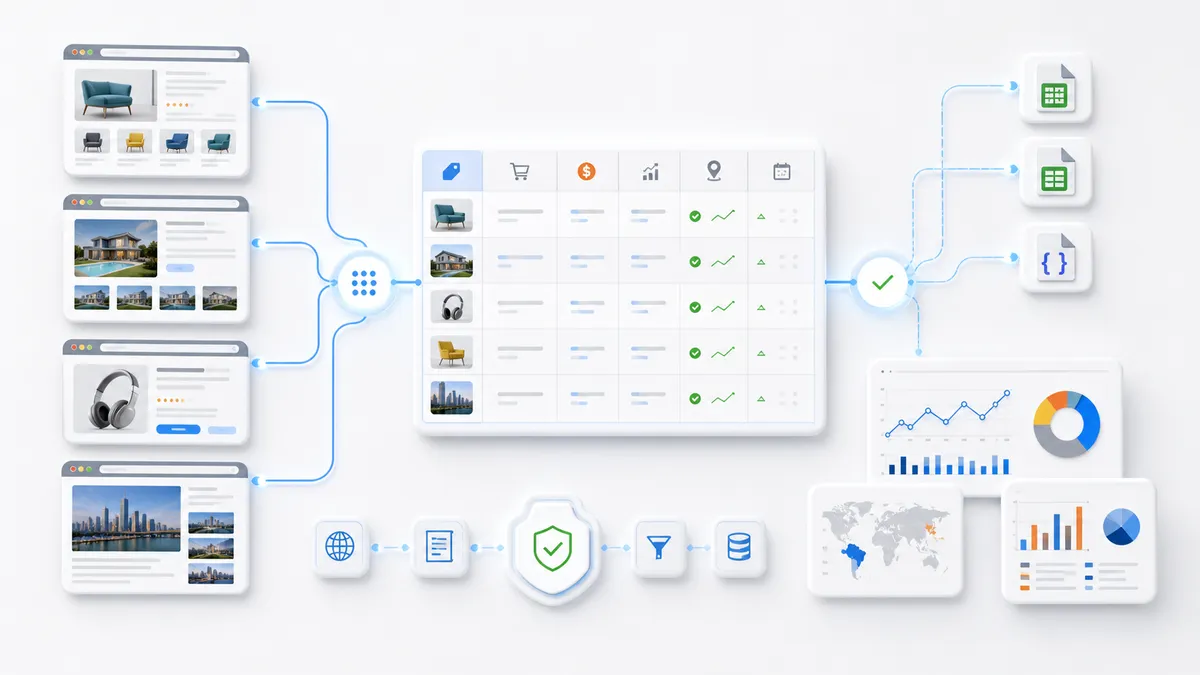
A parser makes sense when manual collection becomes a process
If someone opens websites every week and copies prices, products, listings, or contacts into a spreadsheet, this is no longer a one-time task. It is a process that can be described and partly automated.
Web scraping for business is not magic and not hacking. It is structured collection of open information: where to collect from, which fields are needed, how often to update, and what output format is useful.
What tasks are usually worth automating
Common scenarios include collecting product cards, exporting competitor prices, tracking availability, saving listings, detecting page changes, and preparing data for analysis or import.
A good parser task sounds like this: “Here is a list of pages. I need name, price, link, update date, and availability status. The result should be an Excel file every morning.”
A weak task sounds like: “Collect everything useful from all websites.” It has no boundaries, so it cannot be estimated or checked properly.
Why the output format matters
A parser should not end with just “a file”. It should produce a file people can use. For a manager, Excel is often best. For system import, CSV may fit better. For developers or integrations, JSON can be the right output.
If columns, field names, and update frequency are agreed upfront, the data does not need manual cleanup after every run.
Limits and ethics
I work only with open data and tasks that respect law and platform rules. I do not promise bypassing protections, collecting closed personal data, or putting aggressive load on other websites.
Sometimes source analysis shows that scraping would be unstable or questionable. In that case, it is better to change the source, update frequency, or approach.
What to prepare for an estimate
To estimate the task, prepare source URLs, example pages, the fields you need, the output format, update frequency, and what you plan to do with the data after export.
The clearer the next step after data collection is, the more useful the tool will be. See the web scraping and data collection service for typical inputs, constraints, and deliverables.
Related service
Data collection
I build parsers that collect open website data into CSV, Excel, or JSON so you do not copy prices, listings, contacts, or catalog data by hand.
View service